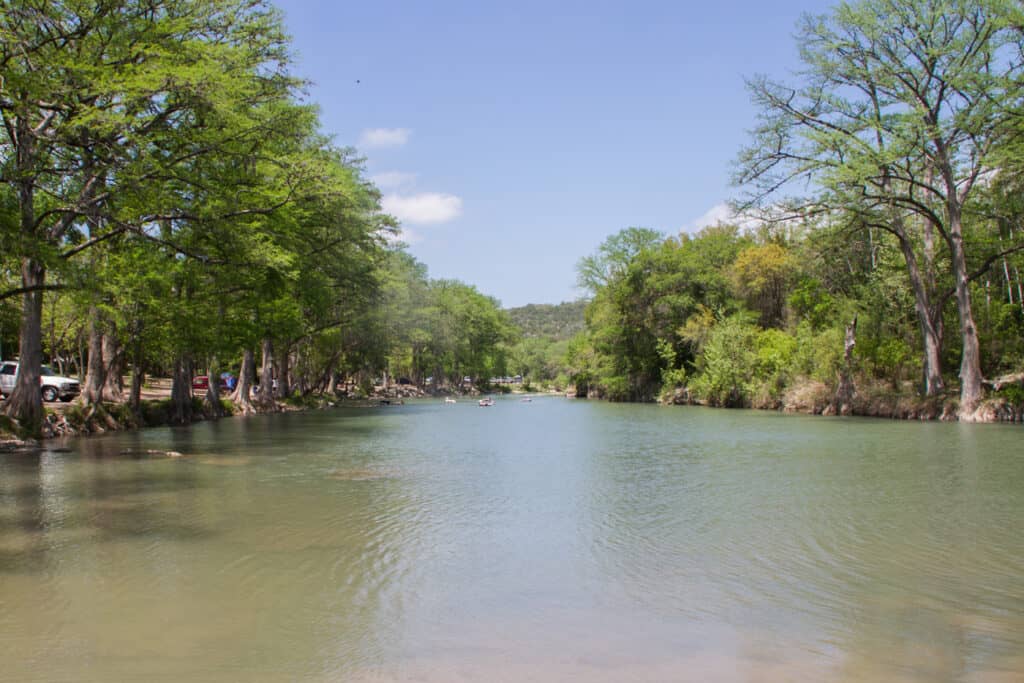
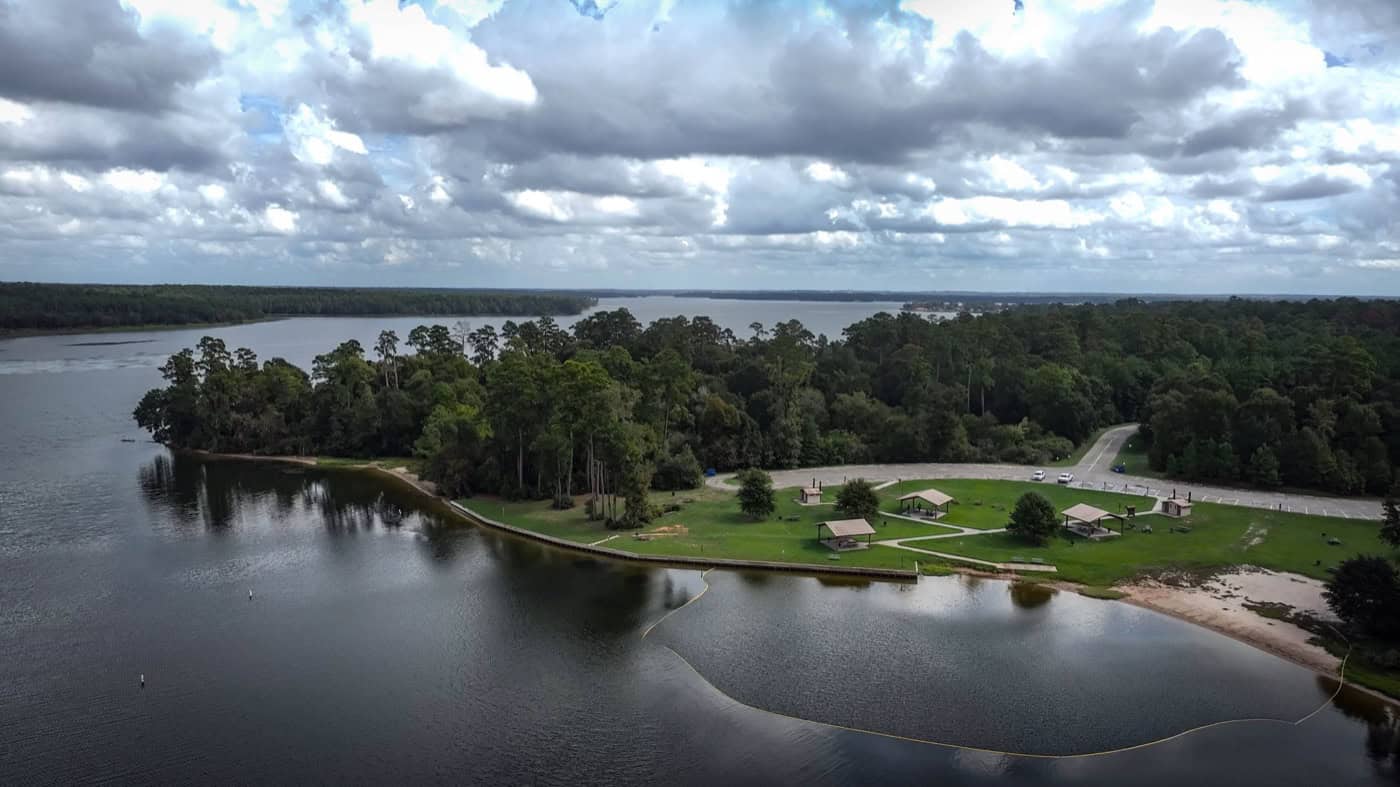
Sam Houston National Forest covers 163,037 acres of East Texas pine forest in Montgomery, Walker and San Jacinto counties, between Huntsville, Conroe and Cleveland, about 1½ hours north of downtown Houston. The USDA Forest Service runs it. It’s best for camping at Cagle and Double Lake and hiking the Lone Star Hiking Trail. From late September to late January, hunting season limits camping to designated sites.
At a Glance
- Drive time: about 1½ hrs from Houston, 3½ from Dallas
- Entry fee: forest free; $5–$7 day use at some sites
- Hours: developed sites 6 a.m. to 10 p.m.
- Reservations: Cagle and Double Lake on Recreation.gov
- Dogs: yes, 6-foot leash; not in swim areas
- Swimming: Double Lake, Scott’s Ridge; summer only
- Camping: Cagle, Double Lake, Stubblefield, Kelly’s Pond
- Best time: October to April
- Hunting season: designated camps only, Sept 26 to late Jan
- Cell signal: spotty; no Verizon at Cagle, per reviews
- Run by: USDA Forest Service, (936) 344-6205
On This Page
- Lone Star Hiking Trail
- Camping
- Swimming, Fishing and Paddling
- Mountain Biking and OHV Trails
- Little Lake Creek Wilderness and Big Creek
- Hunting Season
- Wildlife
- Best Time to Visit
- What Visitors Say
- Getting There
- Know Before You Go
- Nearby Parks
- FAQ
- Sources and Official Links
Lone Star Hiking Trail
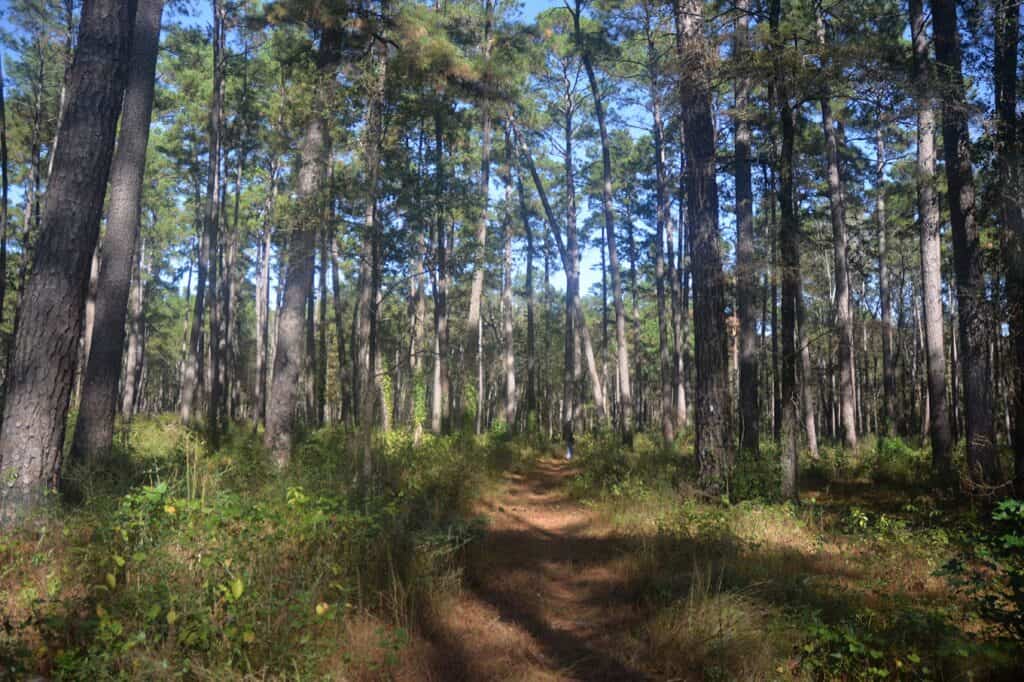
The Lone Star Hiking Trail (LSHT) is the main hiking draw in Sam Houston National Forest: a 96-mile main trail from Trailhead #1 near Richards to Trailhead #15 near Cleveland. With its loops, the Forest Service and the Lone Star Hiking Trail Club count about 128 to 129 miles. It’s free, foot traffic only, and mostly flat.
| Trail | Miles | Starts at |
|---|---|---|
| Lone Star Hiking Trail, main trail | 96 one way | Trailhead #1 (Richards) or #15 (Cleveland) |
| Little Lake Creek Loop (LSHT) | 18.4 | Little Lake Creek Wilderness |
| Double Lake to Big Creek Scenic Area (LSHT) | 5 one way | Double Lake |
| Double Lake Lake Shore Trail | 1.32 | Double Lake |
| Cagle Trail (hikers and bikes) | 2 | Cagle |
| Multiple-Use Trail (bikes, horses, OHVs) | 85 in all | Trailheads 208, 233, Kelly’s Pond, Northwest |
Miles as the Forest Service and the LSHT Club list them.
Trail Tips
- Markers: white metal rectangles on the main trail, colored bands on the loops
- Water: none provided, and trailheads have no restrooms. In dry spells there is no flowing water for 13 miles between Big Creek and the San Jacinto River
- Closures: South Wilderness Trailhead (#5) is closed, and the East Fork San Jacinto River bridge at mile 71.1 is washed out, leaving a ford that turns hazardous in high water. Hikers reported the stretch from Double Lake to Trailhead #12 closed after the Sullivan Fire in January 2026; the Forest Service asks hikers to call the district office for current trail status
- Conditions: hikers in 2025 and 2026 reported fallen trees, overgrowth near Trailhead #1, burned sections and long road walks
- Camping on the trail: allowed along the trail outside hunting season, at least 100 feet from the trail and water, per the LSHT Club. Never in Big Creek Scenic Area, on private land or next to trailheads
Popular day hikes include Trailhead #11 to Double Lake, about 4 miles, and Double Lake to Big Creek Scenic Area. Download the Forest Service trail map (PDF) before going, since cell signal is weak.
Camping
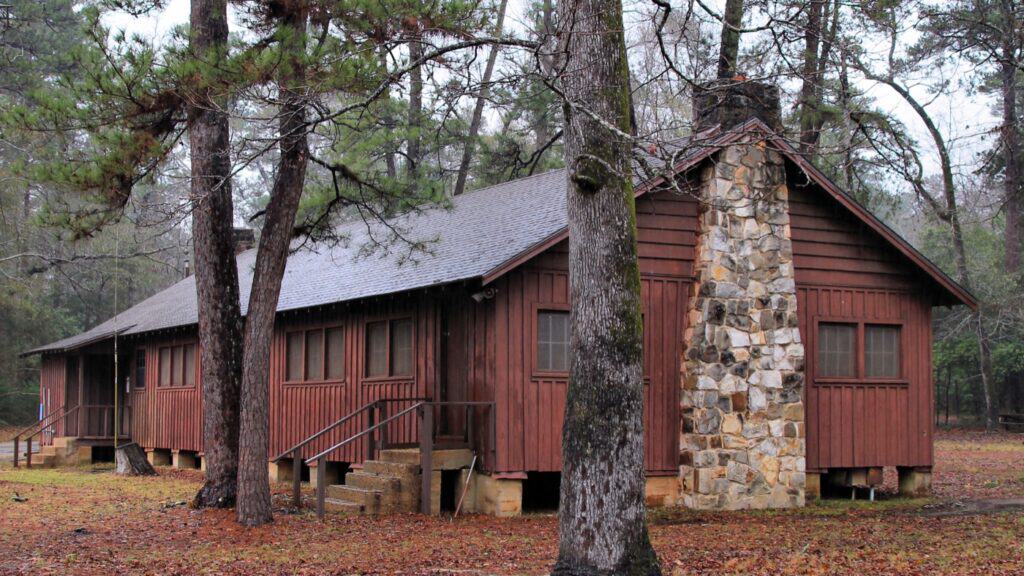
Sam Houston National Forest has three developed campgrounds, Cagle, Double Lake and Stubblefield Lake, plus free walk-in tent sites at Kelly’s Pond and limited dispersed camping. Primitive means no hookups, drinking water or showers.
Campsite Types
- Cagle (47 sites, $30): full hookups with water, sewer and 30- and 50-amp electric on the shore of Lake Conroe, with room for rigs of 40 to 60 feet. Bathhouses with hot showers in each loop. Senior and Access pass holders pay $20
- Double Lake (34 sites, $20 to $32): 22 sites with 50-amp electric and water, 10 of them with sewer, plus 12 non-electric sites, in a recreation area the Civilian Conservation Corps (CCC) built in 1937 around 23-acre Double Lake. Rigs up to 45 feet, and a $5 dump station
- Double Lake group areas (9, $85): non-electric group tent areas for up to 25 people each, plus a lodge (up to 75) and a picnic shelter for day-use reservations
- Stubblefield Lake ($15): non-electric sites with tables, grills and flush toilets, first come, first served. The Forest Service lists no drinking water, so bring it. Campers call it best for tents and short trailers
- Kelly’s Pond (8 walk-in sites, free): very primitive tent sites with a vault toilet and no water or electricity. It doubles as a Multiple-Use Trail trailhead, so expect dirt bikes
- Dispersed camping (free): camping beside a vehicle is allowed only within 150 feet of Forest Service roads 208H and 271, per the Motor Vehicle Use Map. Hikers may camp along the LSHT outside hunting season
Recreation.gov lists a bathhouse at Double Lake, and campers report hot showers at all three developed campgrounds. Double Lake sells no firewood or ice, per campers.
Reservations and Camp Rules
- Booking: Cagle and Double Lake book on Recreation.gov or at 1-877-444-6777. Stubblefield is paid on the Recreation.gov scan-and-pay app, so download it at home
- Check-in: Cagle 2 p.m., check-out noon; Double Lake 4 p.m., check-out 1 p.m.; 14 nights at most
- Site limits: two tents and eight people per site. Double Lake includes two vehicles ($9 a night for each extra); Cagle includes one ($5 a day for each extra)
- Hunting season: designated camps only from September 26 into late January: developed campgrounds, hunter camps and designated hiker camps
- Rules: no alcohol at Cagle or Double Lake; fires in fire rings only
Swimming, Fishing and Paddling
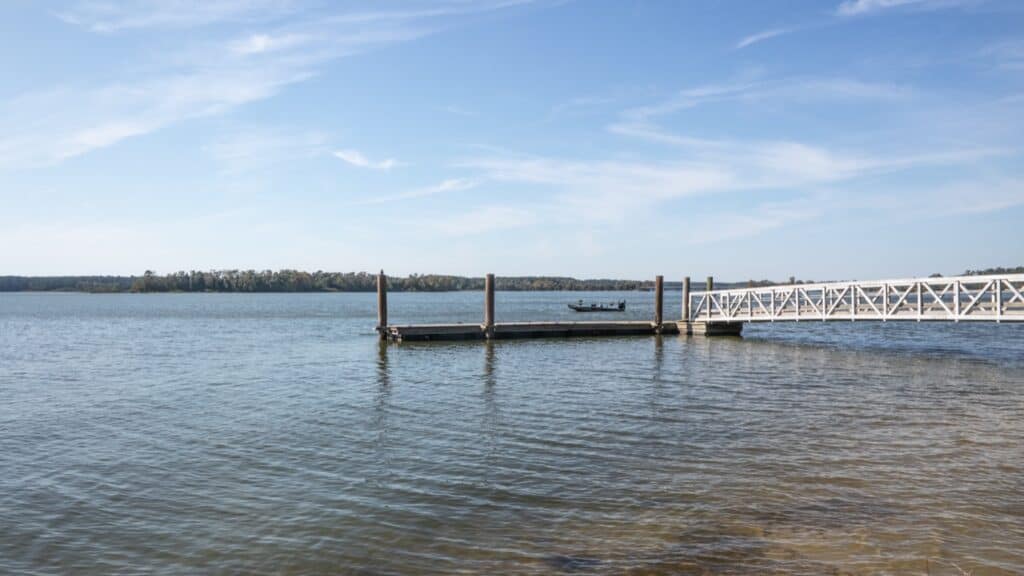
Swimming in Sam Houston National Forest is allowed only at two designated beaches, Double Lake and the Scott’s Ridge Swim Site on Lake Conroe, and only in season. Both were closed for the season on October 30, 2026.
- Double Lake beach: a sandy swim area that opened April 30 in 2026 and closes after summer. Day use is $7 per vehicle. Visitors praise the cleared swim area but report leeches some summers and lily pads across much of the lake
- Scott’s Ridge Swim Site: a beach with three picnic shelters on the west shore of Lake Conroe, open April to September, $5 per vehicle, with a vault toilet and no drinking water. Forest Service page
- No swimming: at Cagle, at Stubblefield or within 100 feet of a boat ramp. No pets, kayaks or paddleboards inside swim areas, and swimming only in daylight
- Fishing: Double Lake is stocked with bass, bream and catfish. Lake Conroe, 22,000 acres, is known for black bass, with ramps at Cagle and Scott’s Ridge. Stubblefield Lake gets the best reviews for bank fishing. State fishing rules apply
- Paddling: Double Lake allows only small electric motors, and Stubblefield is non-motorized. No rentals are listed anywhere in the forest, so bring a kayak
Mountain Biking and OHV Trails
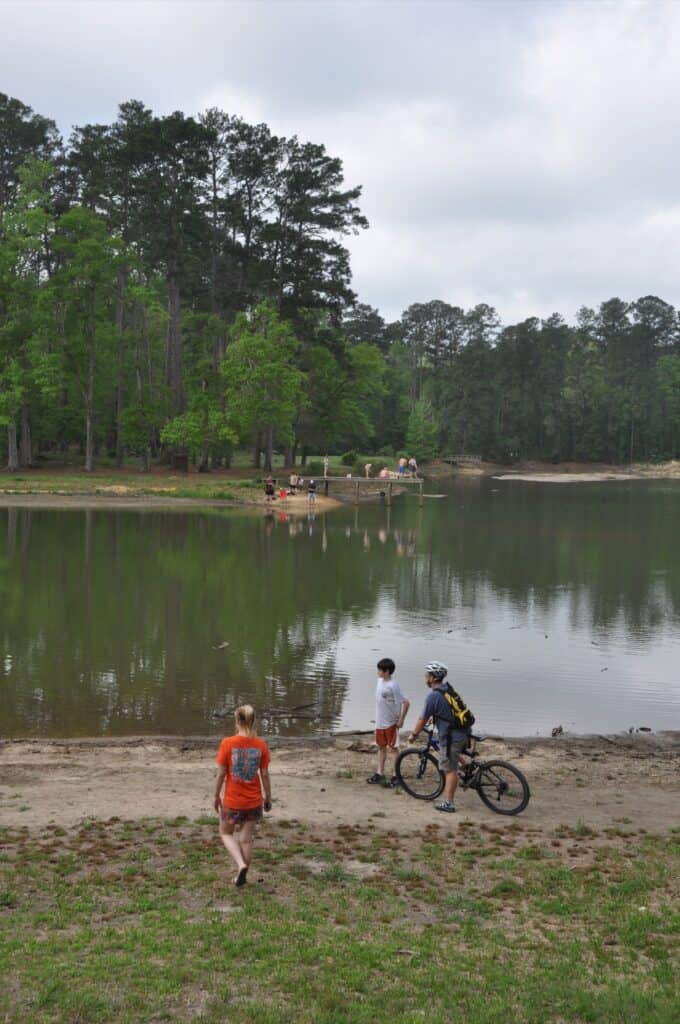
Sam Houston National Forest has the only trail open to off-highway vehicles (OHVs) in Texas’s national forests: the 85-mile Multiple-Use Trail, shared by hikers, mountain bikers, horses and registered OHVs. Bikes aren’t allowed on the Lone Star Hiking Trail or in the wilderness.
- Double Lake bike trail: about 21 miles of single track around the lake per the Forest Service (20 per Recreation.gov). Riders call it flowy and fast, with fallen trees after storms
- Trail pass: $5 per person per day at trailhead pay stations or on Recreation.gov, or a $25 annual Multiple-Use Trail pass
- OHV rules: vehicles 50 inches wide or less, a current Texas OHV decal, a spark arrestor at 96 decibels or less, a helmet and eye protection. ATV riders carry proof of ATV operator education, and every operator carries ID and proof of payment
- Trailheads: 233 (east side), 208 (west side), Kelly’s Pond and Northwest. The 234 trailhead is for horses only, no OHVs
- Trail status: trails close when wet ground could be damaged. Call (936) 344-6205, option 2, before driving out
Only street-legal vehicles may drive Forest Service roads, and OHVs must stay on the designated trail. See the Multiple-Use Trail page for the full rules.
Little Lake Creek Wilderness and Big Creek
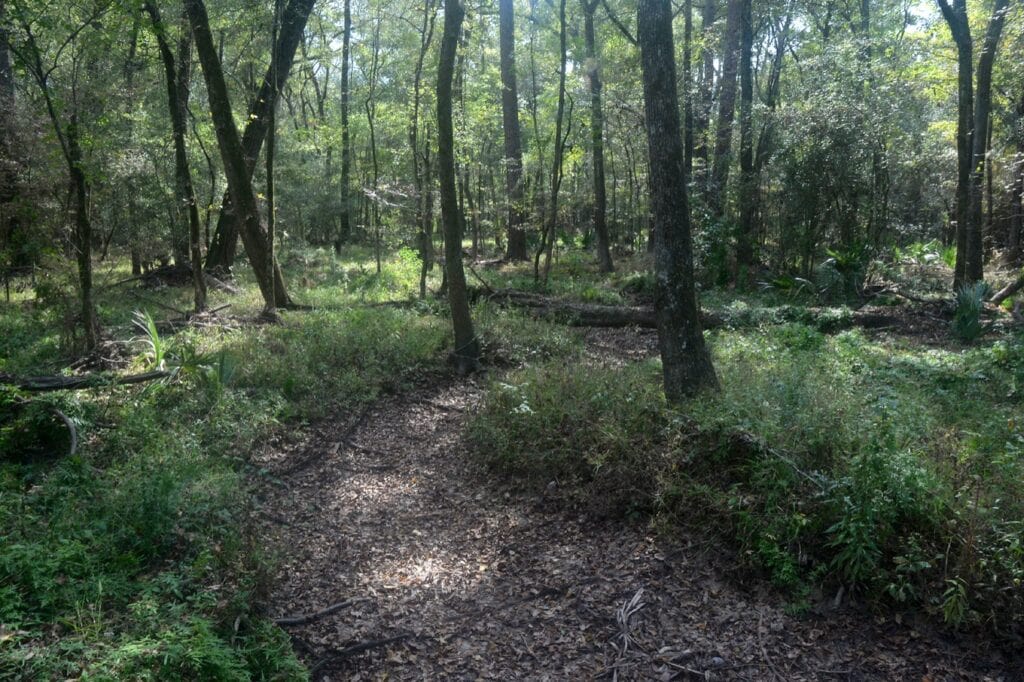
Little Lake Creek Wilderness, 3,817 acres in the forest’s southwest corner, is the forest’s wildest hiking, with the 18.4-mile Little Lake Creek Loop of the LSHT. Congress designated it in 1984.
- Wilderness rules: hiking, horseback riding, hunting, fishing and campfires (when there is no burn ban) are allowed. Bikes, wheeled carts and motor vehicles are not
- Getting there: from Conroe, take I-45 north 8 miles to Willis, FM 1097 west 12 miles, then FM 149 north 3.5 miles to the wilderness parking
- Big Creek Scenic Area: 1,420 acres near Shepherd known for its plant diversity, with four LSHT loops. Parking is off Forest Service Road 217, about 6 miles west of Shepherd. No camping, fee, restrooms or water
- Winters Bayou: the LSHT Club lists Winters Bayou Scenic Area at the trail’s southeast end, by Trailhead #15
Hunting Season
All of Sam Houston National Forest is a public hunting area, run by Texas Parks and Wildlife (TPWD) as the Sam Houston National Forest Wildlife Management Area (WMA). Hunters 17 and older need a hunting license and the Annual Public Hunting Permit.
- Deer seasons 2026–27: archery October 3 to November 6, 2026; early youth October 30 to November 1; general November 7, 2026 to January 3, 2027; late youth and muzzleloader January 4 to 17, 2027
- Hunter orange: TPWD requires everyone, hunters or not, to wear hunter orange in daylight while firearm deer hunting is open
- Camping: designated camps only from September 26. The Forest Service trail page says through January 8; the LSHT Club gives January 24, 2027
- Rules: slugs only (no buckshot), no baiting, portable stands only, and no target shooting anywhere in the WMA. No shooting from, into or across roads, trails, campsites or boat ramps
Check the TPWD WMA page and the Forest Service hunting page for current dates.
Wildlife
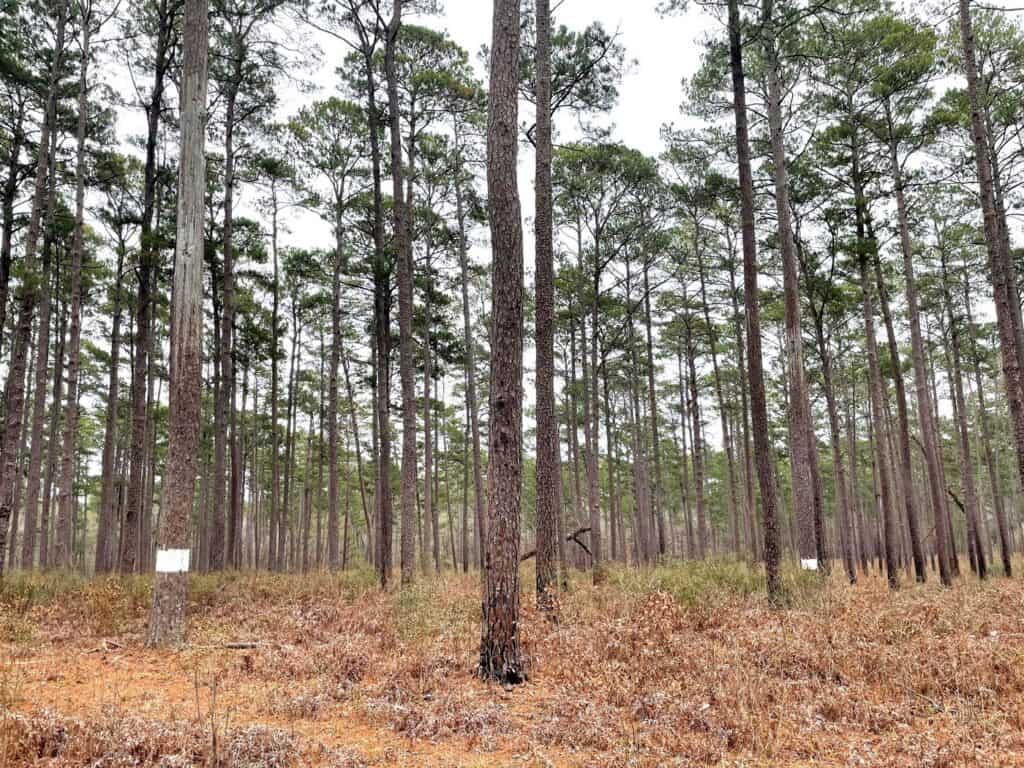
Sam Houston National Forest is home to the red-cockaded woodpecker, an endangered bird of mature Southern pine forests, with colonies in Little Lake Creek Wilderness. White bands painted on pines mark its cavity trees.
- Bald eagles winter around Lake Conroe, per the Forest Service
- Visitors often see deer, turtles and squirrels at Double Lake, and feral hogs along the LSHT
- Hikers report timber rattlesnakes and cottonmouths, the latter at creek crossings
- Ticks, chiggers and mosquitoes are worst from spring through fall
Best Time to Visit
The best time to visit Sam Houston National Forest is October through April, when the woods are cooler and the bugs fewer. Summer is the swimming season but brings heat, humidity and mosquitoes.
- Fall: cooler hiking from October, but hunting season starts, with designated-camp rules from September 26 and the general deer season from November 7
- Winter: the fewest bugs and the quietest campgrounds. A December 2025 thru-hiker saw almost no bugs. Hunting rules last into January
- Spring: redbuds bloom around mid-February and dogwoods in early March, per the Forest Service. Expect prescribed-burn smoke some days
- Summer: the swim beaches are open, but tents get hot and ticks, chiggers and mosquitoes peak
What Visitors Say
Visitors rate Sam Houston National Forest highly. Its main Google listing averages 4.8 stars across 179 reviews from November 2024 to October 2026 (4.6 lifetime from about 4,730). In the same window Cagle averages 4.7 (132 reviews), Double Lake 4.6 (128) and Stubblefield 4.5 (84).
- Quiet: the most common praise: shady, roomy sites under tall pines, close enough to Houston for a weekend
- Campground picks: Cagle for full hookups and lake views, Double Lake for hookups plus a swim beach, Stubblefield for cheap tent camping and fishing
- Hosts: the most divisive topic. Many name helpful hosts, but a few Cagle and Stubblefield reviews describe strict rule enforcement and confrontations
- Lakes: lily pads and weeds on Double Lake, a weedy Lake Conroe shore at Cagle, and leeches in the Double Lake swim area some summers
- Roads: the road into Stubblefield is badly potholed, per several reviews
- Cell signal: no Verizon service at Cagle, repeated in several reviews; patchy elsewhere
Getting There
Sam Houston National Forest has no single entrance. Cagle and Stubblefield sit off I-45 near New Waverly, and Double Lake sits on FM 2025 near Coldspring.
- To Cagle: take I-45 north from Houston to exit 102 (exit 103 southbound) at FM 1375, go west about 5 miles, then turn left at the Cagle sign
- To Stubblefield: from New Waverly, take FM 1375 west 9 miles, then turn right on Forest Service Road 215 for 3 miles
- To Double Lake: take I-69/US 59 north to Cleveland, then FM 2025 north 17 miles and turn right at Double Lake
Drive times:
- Houston: about 1 hour 20 minutes to Cagle (61 miles), about 1 hour 30 minutes to Double Lake (63 miles)
- Dallas: about 3 hours 25 minutes to Cagle (190 miles)
- Austin: about 3 hours 20 minutes to Cagle (156 miles)
- San Antonio: about 4 hours 20 minutes to the ranger district office near New Waverly (240 miles)
A Few Things to Know Before Driving Out
- Forest roads are dirt or gravel. Reviewers single out potholes on the road to Stubblefield
- Heavy storm-recovery road work on Forest Service Road 234, the road to the 234 trailhead, has run since June 2026; expect haul trucks and delays
- Much of the forest has weak or no cell signal, so download maps from the Forest Service maps page first
- The Sam Houston Ranger District office is at 394 FM 1375 West in New Waverly. Call ahead: pass and map sales there are by appointment
Know Before You Go
Fees and passes: the forest has no entrance fee. Day use costs $7 per vehicle at Double Lake and $5 at Cagle and Scott’s Ridge, and the Multiple-Use Trail costs $5 per person per day. The Lone Star Hiking Trail, Big Creek and Kelly’s Pond are free. The $30 National Forests and Grasslands in Texas Annual Day-Use Pass covers Cagle, Double Lake and Scott’s Ridge. The America the Beautiful pass isn’t accepted at any Sam Houston site, but Senior and Access pass holders get 50% off at swim sites and boat ramps. Confirm current fees on the Forest Service Sam Houston page.
Booking: Cagle and Double Lake campsites book on Recreation.gov, about 6 months ahead and at least 2 days before arrival. Stubblefield and Kelly’s Pond are first come, first served. There is no day pass to reserve.
Hours: developed recreation areas are open 6 a.m. to 10 p.m. and close overnight except to campers and their visitors. The ranger district office is open weekdays, 8 a.m. to 4:30 p.m., closed noon to 1 p.m. Veterans Day, November 11, 2026, is a fee-free day.
- Dogs: on a leash of 6 feet or less, or crated. No pets in swim areas except service animals
- Fires: no fires within 300 feet of any designated trail or developed parking area, no fireworks, and no fires or charcoal grills anywhere on the forest when the county has a burn ban. Check Montgomery, Walker and San Jacinto counties with the Texas A&M Forest Service
- Stay limits: 14 days in any 30, no camping within 300 feet of a developed parking area or boat ramp, and no gas generators from 10 p.m. to 6 a.m. outside designated areas
- Water: drinking water at the Cagle and Double Lake campgrounds only. None on the LSHT, at Stubblefield, Kelly’s Pond, Scott’s Ridge or the OHV trailheads
- What to bring: plenty of water, insect repellent with tick protection, an offline map, cash or the Recreation.gov app for fees, and blaze orange in hunting season. Pack out all trash
Check conditions first: trail closures, road work, burn bans and wet-weather trail closures change often. Read the Forest Service alerts page and call the Sam Houston Ranger District at (936) 344-6205 before heading out.
Nearby Parks
State parks and another national forest lie within two hours of Sam Houston National Forest.
- Huntsville State Park (about 30 minutes from Cagle): a state park inside the forest, around 210-acre Lake Raven, with 2 cabins and 26 screened shelters
- Lake Livingston State Park (about 35 minutes from Double Lake): campsites and 10 screened shelters on the southeastern shore of Lake Livingston
- Davy Crockett National Forest (about 2 hours from Double Lake): Ratcliff Lake camping and swimming and the 20-mile 4C Trail
- Big Thicket National Preserve (about 1 hour 45 minutes from Double Lake): a National Park Service preserve of bottomland forest east of the forest
More options: Parks Near Houston.
FAQ
Is Sam Houston National Forest free?
Entering the forest is free, and so is hiking the Lone Star Hiking Trail. Fees apply only at developed sites: $7 per vehicle at Double Lake, $5 at Cagle and Scott’s Ridge, $5 per person on the Multiple-Use Trail, and nightly campsite fees.
Can visitors camp anywhere in the forest?
No. Outside hunting season, hikers may camp along the Lone Star Hiking Trail, and vehicle camping is allowed only within 150 feet of Forest Service roads 208H and 271. From late September to late January, everyone must use designated camps.
Are there cabins in Sam Houston National Forest?
No. The forest has campsites only. The closest cabins are at Huntsville State Park, inside the forest about 30 minutes from Cagle, which has 2 cabins and 26 screened shelters.
Is Sam Houston National Forest a national park?
No. It’s a national forest run by the USDA Forest Service, and it allows hunting, OHV riding and dispersed camping, which national parks don’t. Most of it has no gate or entrance fee.
Sources and Official Links
Facts in this guide were last checked in October 2026 against these sources.
- Sam Houston National Forest (USDA Forest Service)
- Sam Houston Ranger District office
- Double Lake Recreation Area and reservations (Recreation.gov)
- Cagle Recreation Area and reservations (Recreation.gov)
- Stubblefield Lake Recreation Area and scan-and-pay (Recreation.gov)
- Kelly’s Pond Campground
- Scott’s Ridge Swim Site
- Lone Star Hiking Trail (Forest Service), its trail map (PDF) and the Lone Star Hiking Trail Club
- Sam Houston Multiple-Use Trails
- Big Creek Scenic Area and wilderness in Texas national forests
- Motor Vehicle Use Map 2025 (PDF)
- Passes and fees
- Forest Service alerts
- Occupancy and use order and fire order
- Hunting on the National Forests and Grasslands in Texas and the Sam Houston National Forest WMA (TPWD)
Featured photo: Preston Keres, USDA Forest Service, Wikimedia Commons (Public Domain)
Get More Texas Outdoor Adventure Tips
Subscribe to get more places to explore in the great outdoors of Texas. We’ll never share your email. Unsubscribe any time.