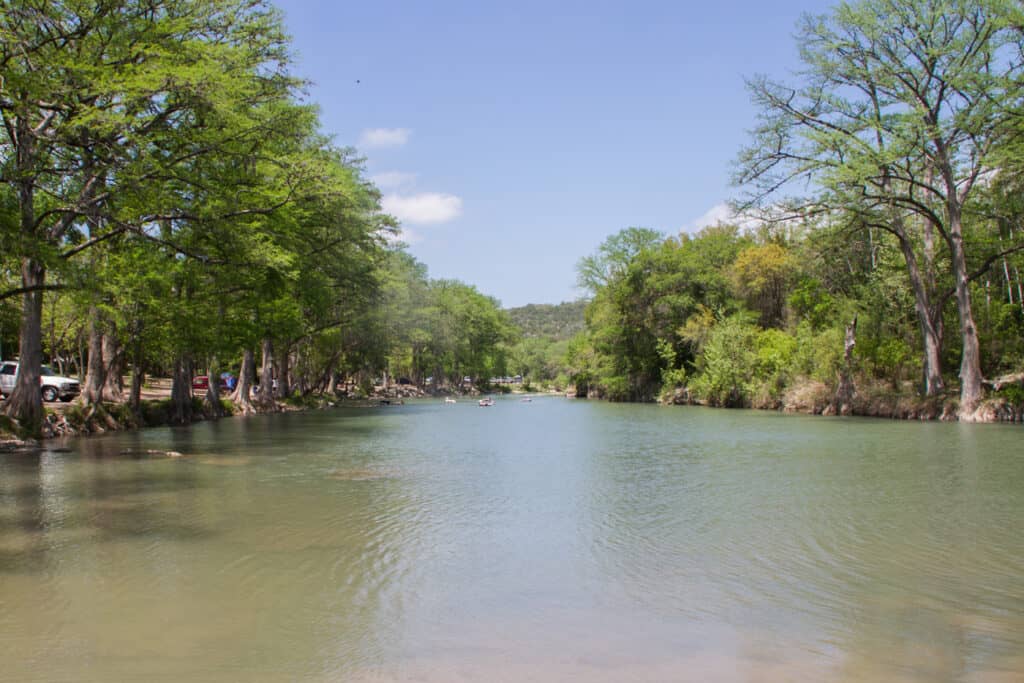
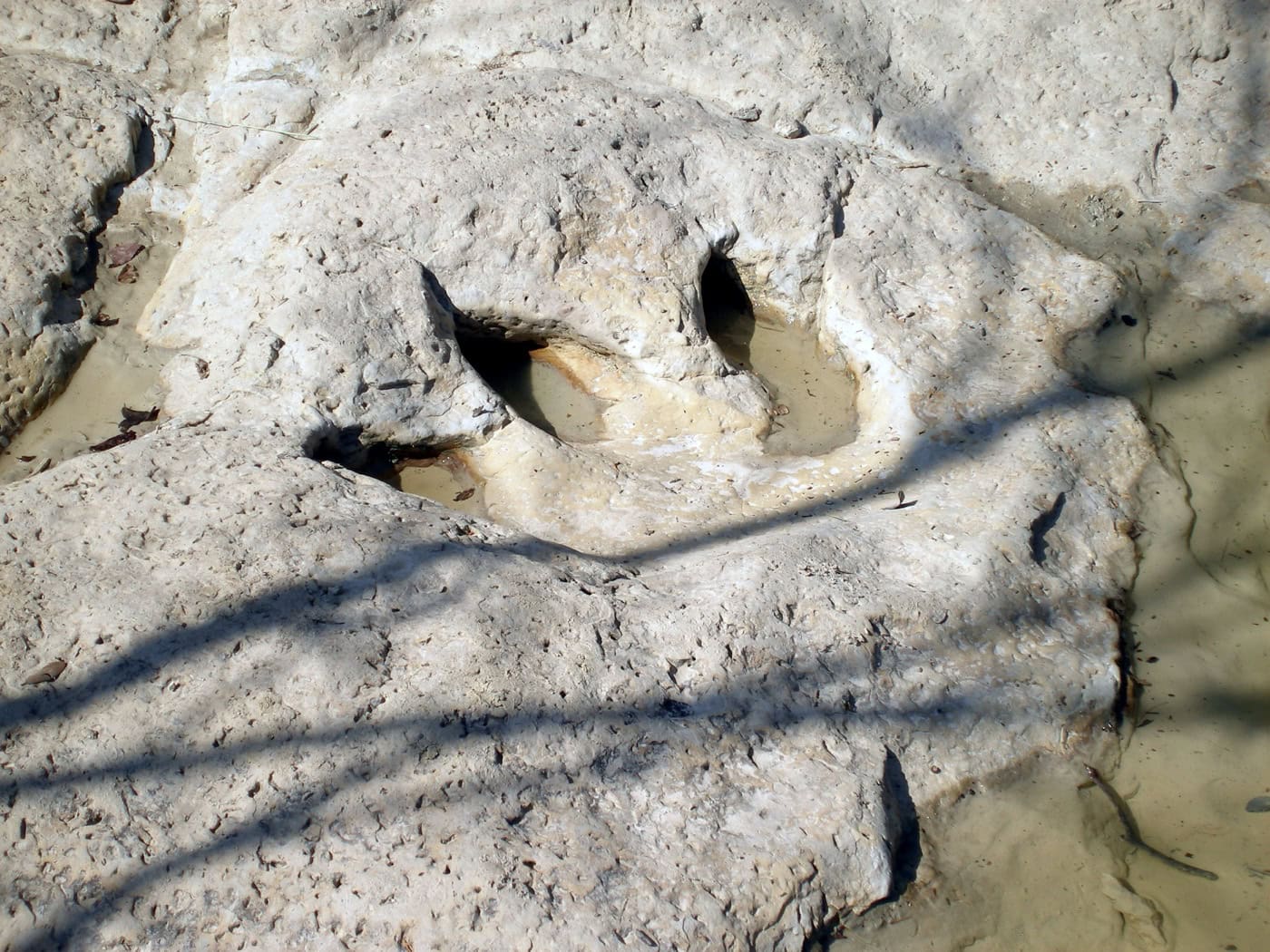
Dinosaur Valley State Park sits on the Paluxy River about 4 miles west of Glen Rose, in Somervell County, about 1 hour 10 minutes from Fort Worth and 1.5 hours from Dallas. It’s known for real dinosaur tracks in the riverbed, plus swimming holes and 20-plus miles of trails. River level decides how many tracks show, so check track conditions and reserve a day pass first.
At a Glance
- Drive time: about 1.5 hrs from Dallas, 3.25 from Austin
- Entry fee: $8 ages 13 and up; 12 and under free
- Hours: 6 a.m. to 10 p.m.; office 8:30 to 4:30
- Reservations: day pass advised; the park often fills
- Dogs: yes, 6-foot leash; not in swim areas
- Swimming: yes, Blue Hole and river; no lifeguards
- Camping: electric, walk-in, hike-in; no cabins
- Best time: late summer to winter, when water is low
- Hunt closures: Dec. 6–10 and Jan. 10–14
- Cell signal: little to none in much of the park
- Run by: TPWD, (254) 897-4588
On This Page
- Dinosaur Tracks
- Hiking and Biking Trails
- Swimming and Fishing the Paluxy River
- Horseback Riding
- The Dinosaur Statues
- Camping
- Best Time to Visit
- What Visitors Say
- Getting There
- Know Before You Go
- Nearby Parks
- FAQ
- Sources and Official Links
Dinosaur Tracks
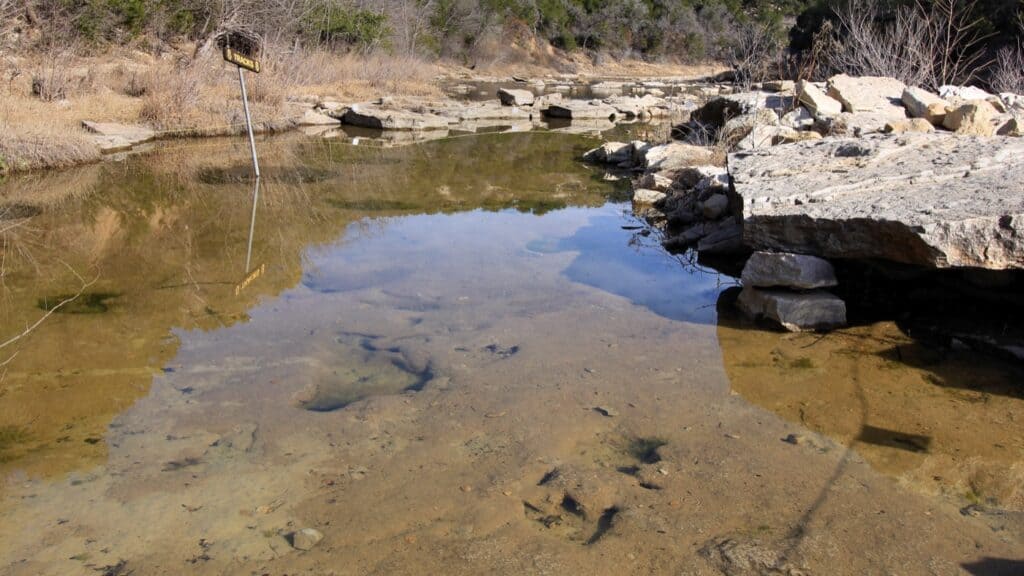
The dinosaur tracks at Dinosaur Valley State Park are real fossil footprints, about 113 million years old, pressed into limestone in the bed of the Paluxy River. Visitors can walk in them. Whether they’re visible on a given day depends on the river: low, clear water shows the most, and rain hides them under water and silt.
Two kinds of dinosaurs left them, according to Texas Parks and Wildlife (TPWD):
- Sauropods: large, round, elephant-like prints, believed to be made by Sauroposeidon proteles, the official state dinosaur of Texas
- Theropods: three-toed prints, believed to be made by Acrocanthosaurus, a meat eater. Some are stretched out with no toes showing, made while the animal sank into deep mud
Where to See Them
TPWD maps five track areas with about 25 named sites along the river. Most visitors start at these:
- Main Track Site: the easiest to reach, near a parking lot and usually dry, with a line of sauropod tracks. The Main Ledge, across the river, holds both kinds
- Blue Hole: a small ledge of three-toed theropod tracks, usually visible under a few inches of water or from the bank
- The Ballroom: the largest site, with nine 36-inch sauropod tracks and many theropod prints. It’s often under sand, mud or water; TPWD says late summer is the best time to see it
- Lone Ranger Site: the longest theropod trail in the park, over 350 feet, but hard to see even when dry
- The Overlook: closed, because the viewing area above the river is unstable
Floods keep wearing the track beds away: about half of the Bird Site has eroded since 1940.
Check Before Driving Out
Tracks can stay hidden for days after rain, so check before a long drive.
- Track status: TPWD posts dated Trails and Tracks Updates for the park. On Oct. 18, 2026, it read “Trails are open. Tracks are visible”
- River gauge: the USGS Paluxy River gauge at Glen Rose, downstream of the park, shows how much water is in the river. On Oct. 30, 2026, it read about 1.3 cubic feet per second, far below the usual 14 for that date
- Track maps: the TPWD tracks page has downloadable maps that show where prints lie even under water, and headquarters staff can point to the most visible tracks that day
Track Tips
- Most track sites are reached by steep slopes or stairs, and replica tracks at headquarters help visitors who can’t reach the river
- Water shoes with grip are the most repeated tip in reviews; the limestone is slick
- Arrive early. Afternoon crowds stir up silt, and waders muddy the water around the prints
- Fossils are protected by law. Leave everything in the riverbed as found
A 9-year-old, George Adams, found three-toed tracks here in 1909. In 1940, paleontologist R.T. Bird excavated tracks from what’s now the Bird Site; pieces are at the American Museum of Natural History in New York and the Texas Memorial Museum in Austin. Rangers lead Track Talk and River Romp programs; the park’s events page lists dates.
Hiking and Biking Trails
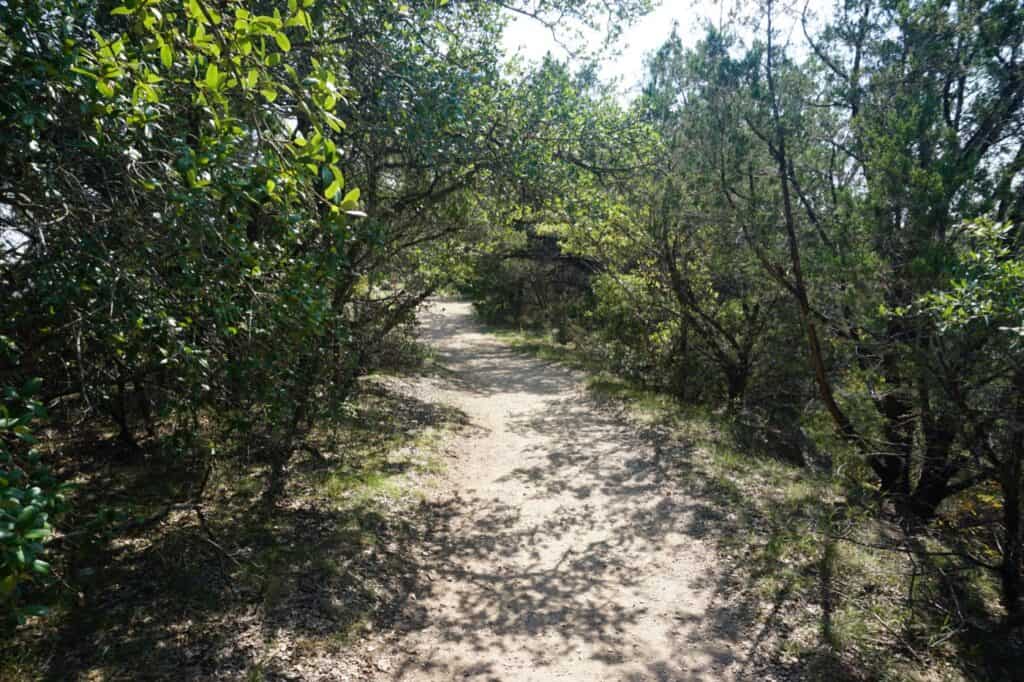
Dinosaur Valley State Park has more than 20 miles of trails, from short loops near the river to a 7.5-mile outer loop through cedar brakes and up limestone ridges. All trails are open to hikers and mountain bikers unless noted. Many start on the far side of the Paluxy River, so reaching them means wading across.
| Trail | Miles | Difficulty |
|---|---|---|
| Discovery Loop Trail | 0.1 | Easy |
| Oak Springs Trail | 0.3 | Easy |
| Monarch Trail | 0.5 | Easy |
| Paluxy River Trail | 2.0 | Easy |
| Rocky Ridge Trail | 1.0 | Moderate |
| Buckeye Trail (small waterfalls possible) | 1.4 | Moderate |
| Limestone Ledge Trail (hiking only; wade to the Main Track Site) | 1.5 | Moderate |
| Denio Trail | 1.6 | Moderate |
| Black-capped Vireo Trail | 2.7 | Moderate |
| Horseshoe Equestrian Trail (horses and hikers; no bikes) | 3.1 | Moderate |
| Overlook Trail (hiking only; river view) | 0.5 | Challenging |
| Cedar Brake Outer Loop | 7.5 | Challenging |
Miles and ratings as TPWD lists them; the park map gives the Limestone Ledge Trail as 1.6 miles. TPWD notes the list may not include every trail.
Trail Tips
- River crossings: the rocks are very slippery, and TPWD suggests boots or waders. After heavy rain the crossing can be too deep to make
- Wet-weather closures: trails close after rain. Reviewers found closures in December 2024, spring 2025 and March and April 2026
- Water: TPWD advises a quart per person per hour; refill at trailheads and campgrounds
- Signs: most reviewers find the trails well kept, but some report confusing junctions. Carry the park trail map (PDF)
- Biking: mountain bikers like the rocky climbs. Bikes aren’t allowed on the Limestone Ledge, Overlook or Horseshoe Equestrian trails
- Birds: endangered golden-cheeked warblers nest in the park from March to July, and black-capped vireos from April to July
Swimming and Fishing the Paluxy River
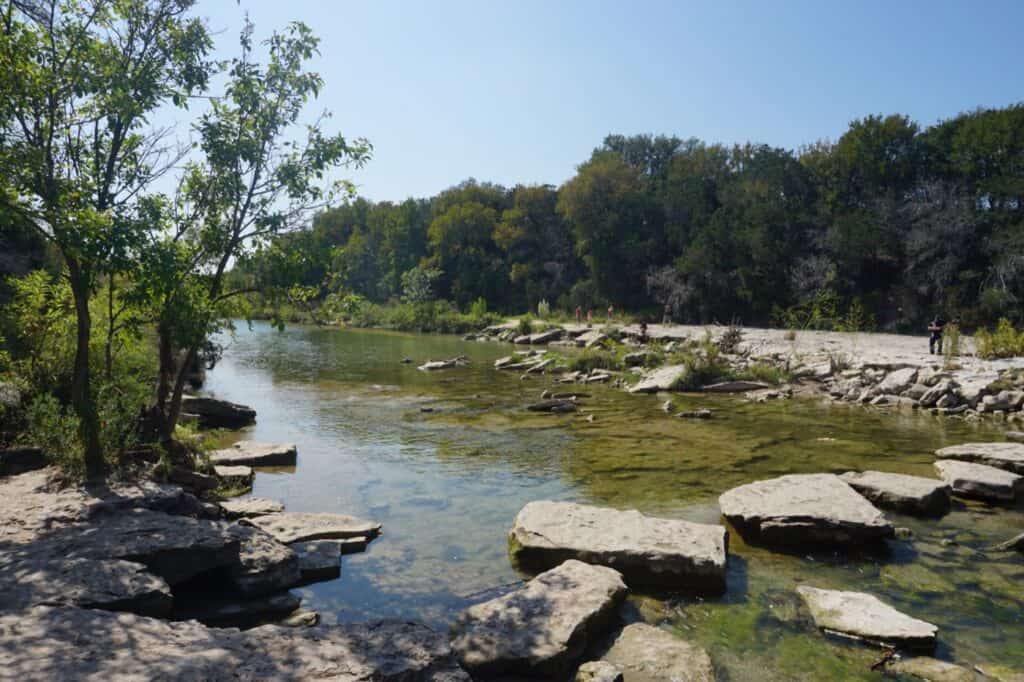
Swimming is allowed in the Paluxy River at Dinosaur Valley State Park, and the Blue Hole is the classic spot, a deep, clear swimming hole near the track sites. There are no lifeguards, so visitors swim at their own risk.
- The river often stops flowing in summer, leaving separate pools. In dry summers reviewers found algae and little water for swimming
- The Blue Hole gets packed on hot weekends
- Pets and glass containers aren’t allowed in swimming areas under statewide park rules
- Stay out when the river is high or muddy after rain. Flash floods can happen
Fishing: no fishing license is needed inside a Texas state park. TPWD lists catfish, largemouth and striped bass, alligator gar, freshwater drum and bluegill in the river, and the Blue Hole is a popular place to cast. The park store lends tackle; reviewers say it doesn’t sell bait.
Paddling: TPWD lists kayaking and canoeing when the river is flowing. It’s often too low in summer and fall, and TPWD lists no rentals.
Horseback Riding
Riders can bring their own horses to the 100-acre South Primitive Area at Dinosaur Valley State Park, a wooded, semi-rocky area with the river running through it. The 3.1-mile Horseshoe Equestrian Trail is the riding route.
- Every horse needs proof of a negative Coggins test
- There’s no drinking water for horses, so bring a bucket for river water
- Trailer parking is available, but there are no overnight facilities for horses
- Eagle Eye Ranch Carriage Company offers guided horseback and wagon rides at the park; call (817) 382-9855
The Dinosaur Statues
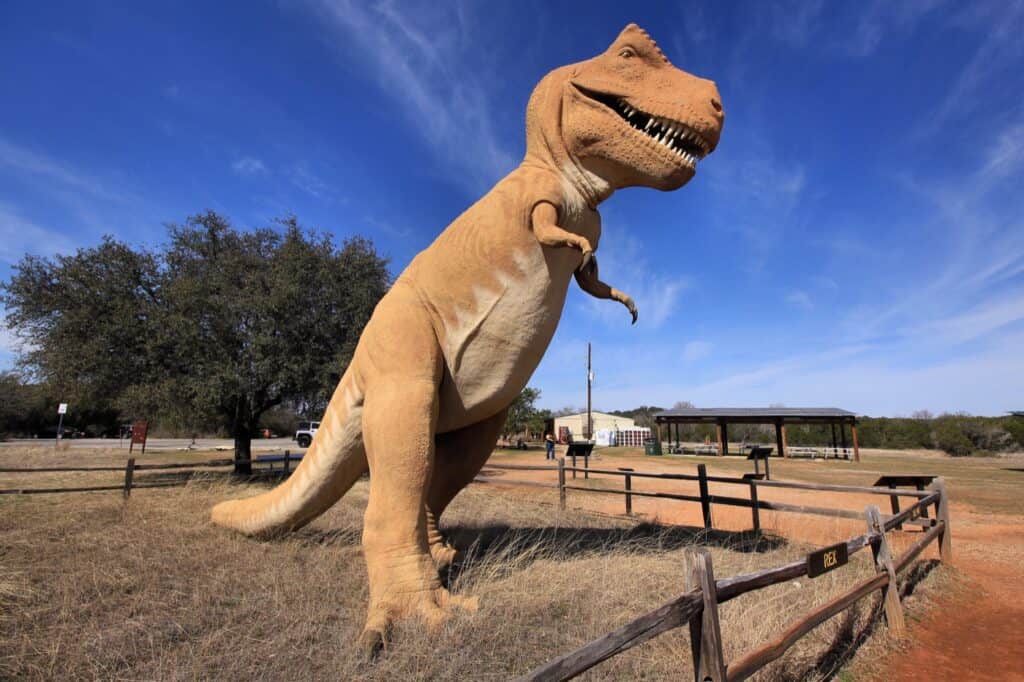
Two big fiberglass dinosaurs stand near headquarters at Dinosaur Valley State Park: a 70-foot Apatosaurus and a 45-foot Tyrannosaurus rex. They were built for Sinclair Oil’s dinosaur exhibit at the 1964–65 New York World’s Fair and have stood at the park since 1970.
They’re the favorite photo stop for families, and the area is wheelchair accessible. The T. rex once had a moving jaw, which has since been removed.
Camping
Camping at Dinosaur Valley State Park ranges from electric sites with water to hike-in primitive sites across the river. There are no cabins or screened shelters. Prices are TPWD’s nightly rates, plus the daily entry fee.
Campsite Types
- Electric sites (36 sites, $26): water and 30-amp electric hookups, picnic table and fire ring with grill in the Lanham Mill area, with restrooms, showers and a family bathroom nearby. All are back-in, with limits of 15 to 35 feet; the 36 include three larger family sites for 16 to 24 people
- Walk-in sites (8 sites, $18): tent sites at Sycamore Bend, a quarter to a half mile on foot from parking, with a fire ring but no water or restrooms. The park store rents wagons for gear
- Hike-in primitive sites (7 sites, $16): at Acro Ridge, 1 to 2.5 miles from parking across the river. A primitive site has no water, restrooms or tables. Campers must wade the Paluxy to get there, fires aren’t allowed, and the sites can be cut off when the river is high
- Sauropod Group Camp (1 site, $60): up to 40 people, a 150-yard walk from parking
- Theropod Group Camp (1 site, $40): up to 20 people
Visitors who want a roof over their heads can look at private RV parks and rentals around Glen Rose; they aren’t part of the state park.
Reservations and Camp Rules
Spring break and holiday weekends fill months ahead, so book early.
- Campsites open for booking 5 months ahead; group camps 12 months ahead. TPWD says to book group camps by phone at (512) 389-8920
- Check-in is 2 p.m. and check-out is noon
- Up to 8 people per site; quiet hours run 10 p.m. to 6 a.m.
- Trailers over 35 feet don’t fit, and TPWD cancels reservations for units longer than the site allows
- Fires only in the rings provided, and gathering firewood is prohibited. Burn bans happen in drought
Campers praise the clean, air-conditioned bathhouses and the cedar and oak shade, but say sites sit close together and some RV pads are small or not level.
Best Time to Visit
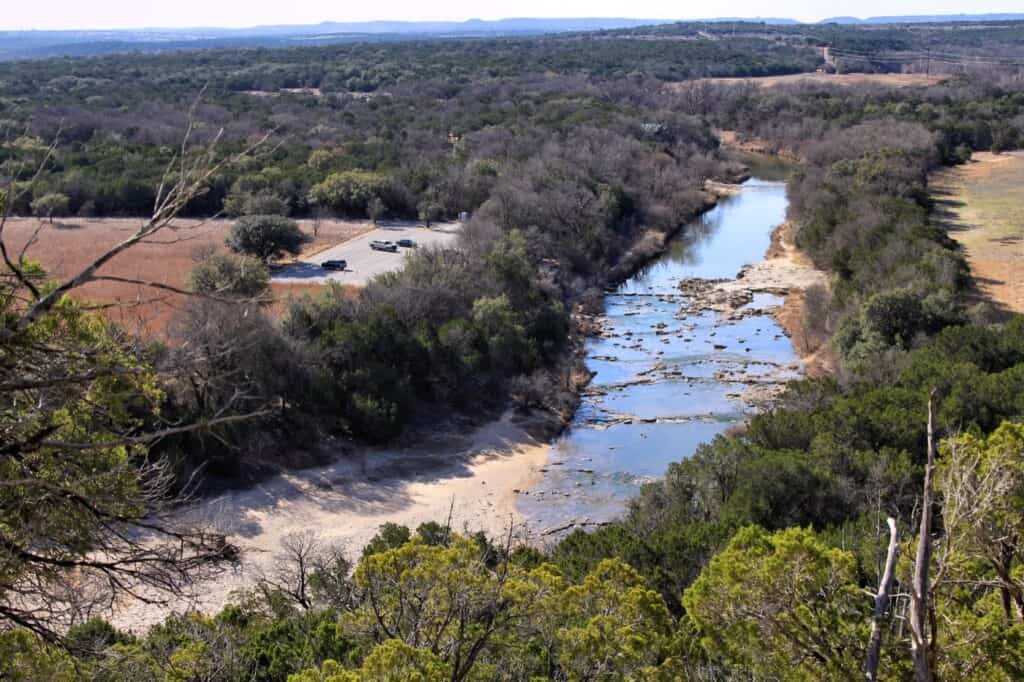
For the dinosaur tracks, the best time to visit Dinosaur Valley State Park is late summer through winter, when the river is usually low and clear. Spring rains often hide the tracks and close the trails, and summer brings heat and crowds.
- Spring (March to May): busy, with spring break weekends selling out. Rain often raises the river and closes trails, so tracks can be hard to see
- Summer (June to August): hot, and reviewers say the valley feels hotter than the Glen Rose forecast. The river often slows to pools, which exposes tracks but leaves little swimming water. Visit early in the day
- Fall (September to November): low water in dry years, as in 2025 and 2026, shows the most tracks. TPWD’s busy season runs March through November
- Winter (December to February): quiet, with clear water that makes underwater tracks easy to see. Plan around the hunt closures. The park’s New Year’s Day hike drew 931 people in 2026, the most of any Texas state park
What Visitors Say
Dinosaur Valley State Park averages 4.8 stars across about 670 Google reviews from late 2024 to October 2026, and 4.7 stars across about 4,900 reviews in all. Most visitors love standing in a real dinosaur track, and the complaints are consistent.
- Tracks and water: the most common topic. Visitors in dry spells saw tracks clearly, while those who came after rain often found them under water or silt
- Crowds: weekends and holidays get busy, and the park was full by 10 a.m. on a March 2026 Saturday. Early arrivals had track sites to themselves
- Bathrooms: the campground bathhouses get praise; day-use restrooms can be dirty on busy days
- Fees: most call it a cheap day out, though a few dislike that the fee is per person, not per car
- Cell service: little to none in much of the park. One visitor reports free Wi-Fi near the entrance
- Staff: headquarters and store staff get praise for being friendly and helpful
- Downsides: falls on the slick riverbed, afternoon noise on busy days, heat and confusing trail signs
Getting There
Dinosaur Valley State Park is about 5 miles by road from downtown Glen Rose. From US 67 in Glen Rose, take FM 205 north to Park Road 59, then follow it about a mile to headquarters.
Drive times to park headquarters:
- Fort Worth: about 1 hour 10 minutes
- Dallas: about 1 hour 35 minutes
- Austin: about 3 hours 15 minutes
- San Antonio: about 4 hours 20 minutes
- Houston: about 5 hours
A few things to know before driving out:
- Day pass first: book online before leaving home, since cell signal is weak at the park
- After hours: visitors arriving when the office is closed pay at the self-pay station at headquarters, where park maps are also kept
- Food: Glen Rose, about 8 minutes away, has restaurants
Know Before You Go
Dinosaur Valley State Park is a river park first. These fees, rules and tips matter most.
- Fees and passes: $8 a day for visitors 13 and older; children 12 and under get in free. The Texas State Parks Pass ($70 a year) covers entry, and pass holders can reserve day passes at no cost
- Booking: day passes open 1 month ahead and often sell out on weekends and holidays; an evening pass covers 5 to 10 p.m. Campsites open 5 months ahead
- Hours: the gate is open 6 a.m. to 10 p.m. daily; the office is open 8:30 a.m. to 4:30 p.m.
- Dogs: allowed on a leash of 6 feet or less, including at hike-in sites, but not in buildings or in or around swimming areas. Bring proof of rabies vaccination
- What to bring: water shoes, plenty of drinking water (none along the trails), sun protection and food
- Hunts: the whole park closes for public hunts from 10 p.m. Dec. 6 to noon Dec. 10, 2026, and 10 p.m. Jan. 10 to noon Jan. 14, 2027
- Fires: Somervell County was on the state burn-ban list in early October 2026, and the park banned wood and charcoal fires in November 2025. Check before bringing firewood
- Wildlife: reviewers report water snakes along the river and biting flies in summer
- Accessibility: the park lends an all-terrain GRIT Freedom Chair, two motorized track chairs and a hiking cart; reserve by phone or email through the accessibility page
- Park store: the Dino-Store sells snacks, drinks, ice, firewood and camping basics, but no meals
Check conditions first: rain can hide the tracks, close the trails and make the river crossing unsafe within a day. Check the Trails and Tracks Updates and the park alerts page, or call (254) 897-4588 before driving out.
Nearby Parks
Three other TrekTexas guides are within about 90 minutes of Dinosaur Valley State Park.
- Lake Whitney State Park: about 57 miles southeast, with lake swimming, fishing, boating and plenty of campsites
- Lake Mineral Wells State Park: about 62 miles north, with a lake, a rock climbing area and miles of trails
- Cedar Hill State Park: about 67 miles northeast on Joe Pool Lake, with 350 campsites and a historic farm
- More parks within reach of Dallas: Parks Near Dallas
FAQ
Are the dinosaur tracks at Dinosaur Valley real?
Yes. They’re real fossil footprints, about 113 million years old, left in mud that turned to limestone. TPWD says the park holds the world’s first discovered sauropod trackway.
Are there cabins at Dinosaur Valley State Park?
No. The park has electric, walk-in, hike-in and group campsites only, with no cabins or screened shelters.
Can visitors take fossils or rocks from the river?
No. Fossils are protected by law, and collecting anything is prohibited in Texas state parks.
Is Dinosaur Valley State Park good for kids?
Yes. Families are its biggest group of visitors, and the park lends a Junior Ranger Explorer Pack. Small children may find the slick, uneven riverbed hard going when the water is up.
Sources and Official Links
Facts in this guide were last checked in October 2026 against these sources.
- Dinosaur Valley State Park (TPWD)
- Entrance fees and campsites (TPWD)
- Dinosaur tracks and track maps (TPWD)
- Trail list and park map (PDF) (TPWD)
- Trails and Tracks Updates and park alerts (TPWD)
- Park history (TPWD)
- Texas State Parks reservations
- Paluxy River at Glen Rose gauge (USGS)
Featured photo: Diane Turner, Wikimedia Commons (CC BY 2.0)
Get More Texas Outdoor Adventure Tips
Subscribe to get more places to explore in the great outdoors of Texas. We’ll never share your email. Unsubscribe any time.