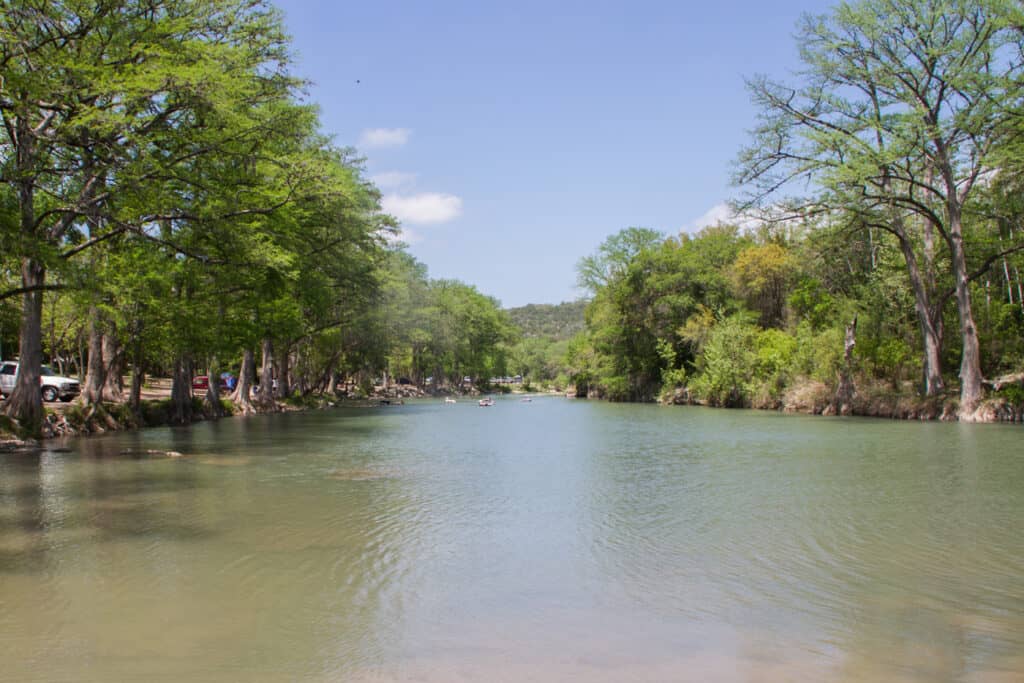
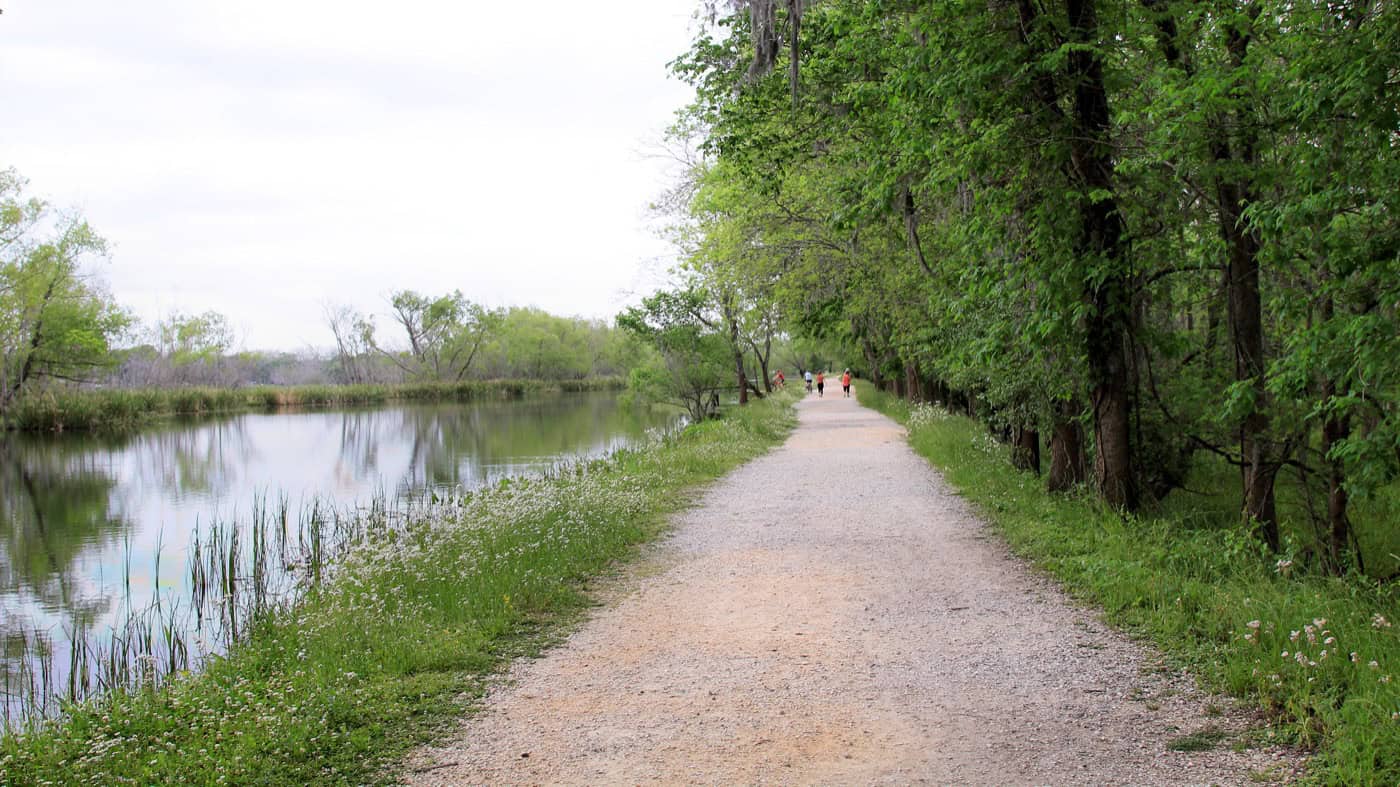
Brazos Bend State Park covers about 5,000 acres along the Brazos River in Fort Bend County, near Needville, about an hour southwest of downtown Houston. It’s best known for wild alligators, seen on most mild days from the flat trails around 40 Acre Lake and Elm Lake, plus 37 miles of trails and the George Observatory. The park often fills, so reserve a day pass before driving out.
At a Glance
- Drive time: about 1 hr from Houston, 3.25 from Austin
- Entry fee: $7 ages 13 and up; 12 and under free
- Hours: 8 a.m. to 10 p.m. daily
- Reservations: day pass advised; the park often fills
- Dogs: yes, 6-foot leash; keep out of the water
- Swimming: no swimming or wading anywhere
- Camping: electric and walk-in sites, shelters, 1 cabin
- Best time: mild, sunny days, October to April
- Hunt closures: Nov. 17–19 and Dec. 15–17, 2026
- Burn ban: no wood fires since Aug. 28, 2026
- Run by: TPWD, (979) 553-5101
On This Page
- Where to See Alligators
- Hiking and Biking Trails
- Birding and Wildlife
- Fishing
- George Observatory
- Nature Center and Programs
- Camping, Screened Shelters and the Cabin
- Best Time to Visit
- What Visitors Say
- Getting There
- Know Before You Go
- Nearby Parks
- FAQ
- Sources and Official Links
Where to See Alligators
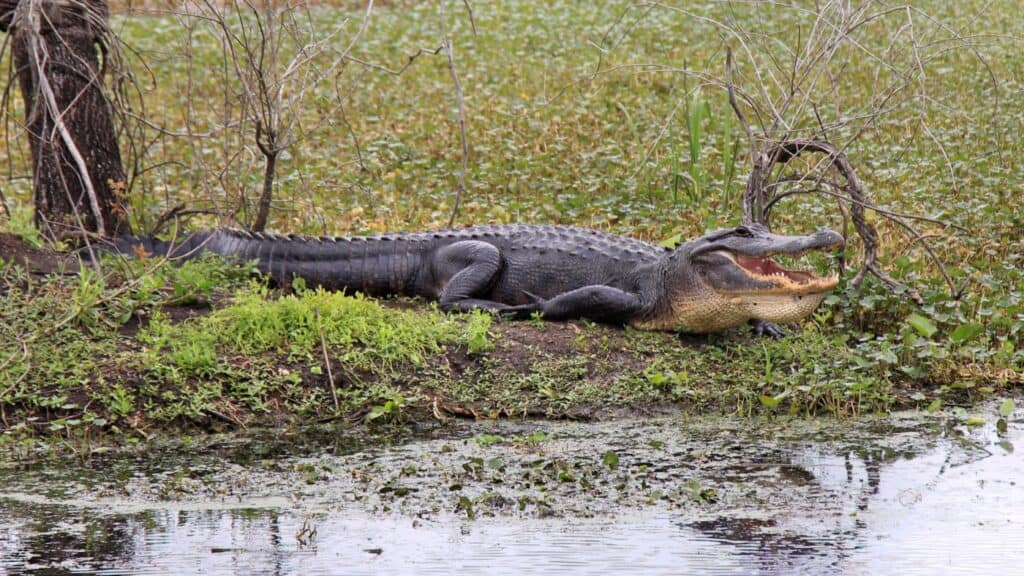
Brazos Bend State Park is one of the easiest places near Houston to see wild American alligators. The best spots are the 40 Acre Lake Trail and the Elm Lake Loop, where alligators bask on the banks and sometimes on the trail itself. Texas Parks and Wildlife (TPWD) says reptiles are easiest to see on mild days in spring, fall and winter.
Where and When to Look
- 40 Acre Lake: the 1.2-mile loop around the lake and the observation tower at its north end give the widest views. TPWD calls it a good trail for alligators
- Elm Lake: the 1.7-mile Elm Lake Loop has a wildlife viewing platform, and TPWD lists it as the most popular trail for wildlife. Visitors also spot alligators at Horseshoe and Creekfield lakes
- Timing: sunny, cool or mild days bring them out to bask. On hot summer afternoons they stay in the water, and some visitors see only one or two
- How many: reviewers commonly count 10 to 20 on a two-hour walk in good weather, and regulars report far more on winter days
Alligator Rules
Alligators here are wild, and TPWD posts safety rules on the park map and on signs along the trails.
- Stay at least 30 feet away. An alligator that opens its mouth and hisses is warning people to back away slowly
- Never feed or bother an alligator. Feeding one in a state park is a Class C misdemeanor with a fine of up to $500
- Give a wide berth to an alligator lying on a trail or bank, and wait or turn around rather than passing close
- Stay clear of piles of grass, twigs or soil beside the trails. They may be nests, with the mother nearby
- Keep dogs on a short leash in the middle of the trail, away from the water. Dogs may not drink from or enter the lakes
TPWD’s alligator safety page has the full list.
Hiking and Biking Trails
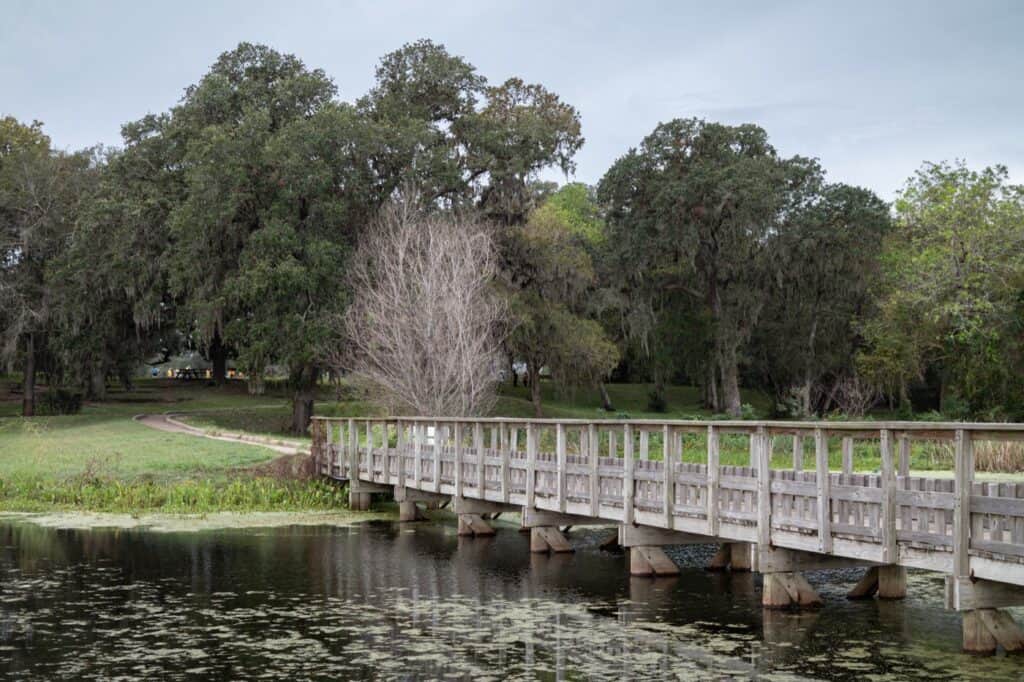
Brazos Bend State Park has 37 miles of trails, according to TPWD, and nearly all of them are flat. Most loop around lakes and sloughs on paved, gravel or dirt paths, so they suit families, beginners and bikes. TPWD rates most trails moderate, but visitors describe them as easy walking.
| Trail | Miles | Best for |
|---|---|---|
| 40 Acre Lake Trail | 1.2 | Alligators, observation tower |
| Elm Lake Loop | 1.7 | Alligators, viewing platform |
| Creekfield Lake ADA Trail (paved, no bikes) | 0.5 | Wheelchairs, strollers |
| Horseshoe Lake Loop | 1.2 | Bank fishing |
| Hale Lake Loop | 1.9 | Longer lake loop |
| Prairie Trail | 1.3 | Prairie viewing platform |
| Big Creek Loop | 1.7 | Along Big Creek |
| Bayou Trail | 1.4 | Beginner mountain biking |
| River View Trail | 1.7 | Brazos River views |
| Yellowstone Landing Trail | 0.24 | Brazos River overlook |
| Creekwood Lake Trail, long loop | 3.3 | Longest trail on the map |
Miles from TPWD’s trail list, except the Creekwood Lake Trail, which appears only on the park trail map (PDF). TPWD lists 24 named trails adding up to about 25 miles, and its map shows about 31; the 37-mile total may include the equestrian and backcountry trails.
Trail Tips
A few things make the trails at Brazos Bend easier.
- Bikes: bikes are allowed on every trail except the Creekfield Lake ADA Trail and the Observatory Trail. TPWD lists no bike rentals
- Horses: 13 miles of multiuse trails north of Big Creek are open to horses. Riders bring their own horses and a current negative Coggins test
- Wet weather: some trails close after rain. Reviewers say the closures aren’t always posted at the entrance, so ask at headquarters before starting a long loop
- Accessibility: the Creekfield Lake ADA Trail is a paved half-mile loop with a boardwalk. The park loans three all-terrain chairs; reserve one at (979) 553-5101, ext. 0
Birding and Wildlife

TPWD has documented more than 300 bird species at Brazos Bend State Park, and says any time of year is a good time for birding. Wading birds feed along the shallow lake edges, often close to the trails.
- Birds visitors report: great blue herons, egrets, white ibis, roseate spoonbills, anhingas, black-bellied whistling ducks, yellow-crowned night herons and red-shouldered hawks
- Where to look: the Elm Lake platform, the 40 Acre Lake observation tower and the Creekfield Lake boardwalk. Rangers set up spotting scopes at the platform and tower during programs
- Other wildlife: visitors report white-tailed deer, armadillos, raccoons, turtles and feral hogs, plus snakes, including venomous cottonmouths near the water
Fishing
Fishing at Brazos Bend State Park is from piers and the bank only, since boats aren’t allowed on the lakes. No fishing license is needed to fish from the shore or a pier inside a Texas state park.
- Piers: fishing piers stand on 40 Acre Lake and Hale Lake, and a small pier sits on Creekfield Lake
- Bank fishing: TPWD marks bank fishing at Elm Lake and calls the Horseshoe Lake Loop an excellent spot for it
- Brazos River: the short Yellowstone Landing Trail leads to a river overlook that TPWD lists as a good fishing spot
- What bites: anglers report bluegill, perch, bass and catfish. Reviews call the fishing hit or miss, and the lakes ran very low in spring 2026
- Alligators: if an alligator goes after a hooked fish, cut the line and let it have the fish. Never leave fish scraps on the shore or in the water
George Observatory
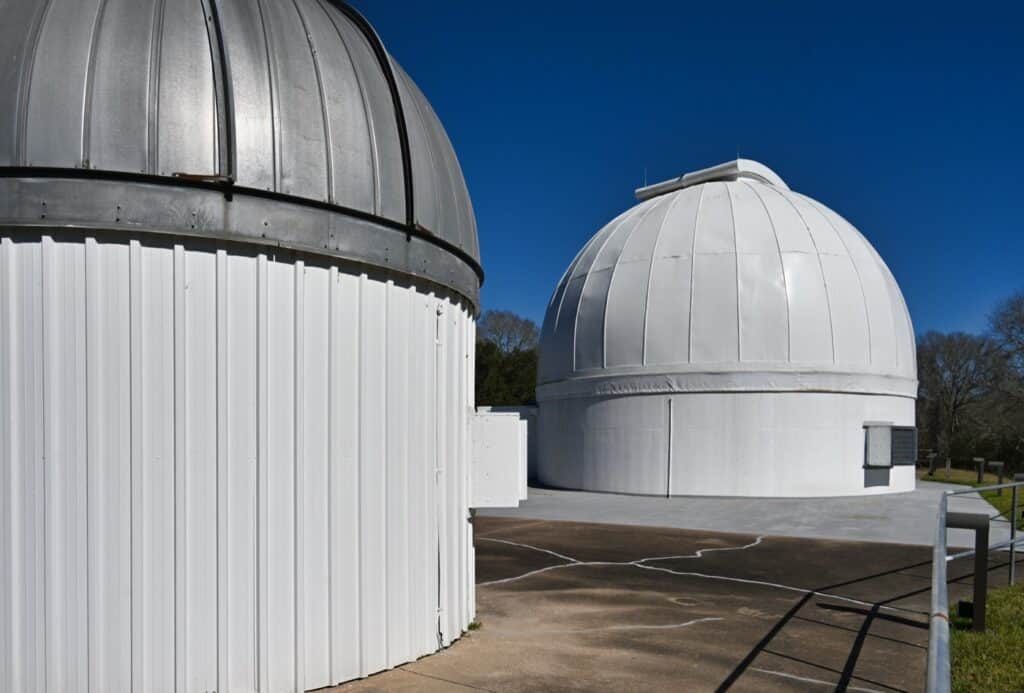
The George Observatory sits inside Brazos Bend State Park but is run by the Houston Museum of Natural Science (HMNS), not TPWD. It holds public stargazing on Saturday nights all year, weather permitting, with a 36-inch research telescope.
- Tickets: $13 for ages 3 and up, sold online in advance only, with none sold at the door. Visitors say Saturdays can sell out weeks ahead
- Park entry: the ticket doesn’t include park entry, so buy a park day pass too. The 5 to 10 p.m. entry slot fits most stargazing nights
- Hours: the HMNS pages list both 7 to 10 p.m. and 9 to 11 p.m., likely by season. Check the HMNS admission page for the night’s times
- Weather: on cloudy nights HMNS holds an indoor program instead, and it cancels only for rain. Reviewers note tickets aren’t refunded for clouds
- What visitors say: Saturn’s rings and Jupiter’s moons are the highlights. The main complaint is that the two main telescopes show their view on a screen, not through an eyepiece
- Getting there: visitors park in the observatory lot and walk a lit path of about a third of a mile
The observatory line is (281) 242-3055.
Nature Center and Programs
The nature center is the park’s main stop for kids. The park map lists its hours as 11 a.m. to 3 p.m. on weekdays and 9 a.m. to 5 p.m. on weekends, but TPWD says hours vary with staffing, so call ahead.
- Hands-on animals: visitors say the highlight is touching a baby alligator, with volunteers on hand
- Free weekend programs: TPWD runs free programs and guided hikes every weekend, such as birding hikes, an alligator talk and night sky programs. The park events page lists dates
- Junior Naturalist: kids can work through a self-guided activity and earn a patch
Camping, Screened Shelters and the Cabin
Camping at Brazos Bend State Park ranges from walk-in tent sites to water-and-electric RV sites, plus 13 screened shelters and one small cabin. Every site type has restrooms with showers nearby. There are no sewer hookups.
Campsite Types
Prices are TPWD’s per-night rates, plus the daily entry fee.
- Electric sites, Burr Oak (40 sites, $25): water and 50-amp electric, paved back-in spurs that the reservation site lists at 49 to 66 feet
- Electric sites, Red Buckeye (33 sites, $25): water and 30-amp electric, back-in spurs of 35 to 57 feet
- Primitive walk-in sites (6 sites, $12): tent sites 35 to 70 yards from parking, with water nearby. A walk-in site is a tent site a short walk from the car
- Screened shelters (13, $25): 12-by-12-foot rooms with screen walls, a ceiling fan, a 20-amp outlet and water nearby. Bring bedding; no pets inside
- Cabin (1, $75 plus a $25 deposit): a converted shelter with air conditioning, heat and a bunk bed, but no mattresses and no bathroom inside. No pets
- Youth group camps (3, $25 to $40): for nonprofit youth groups only, with no electricity
TPWD and the reservation site count slightly differently: the reservation site lists 67 electric sites and 7 walk-in sites. RV campers empty tanks at the dump station near the entrance.
Reservations and Camp Rules
Weekend sites, shelters and the cabin book up months ahead in spring and fall.
- Campsites, shelters and the cabin open for booking 5 months ahead; group camps 12 months ahead, by phone at (512) 389-8920
- Check-in is 2 p.m. and check-out is noon; the cabin is 3 p.m. to 11 a.m.
- Up to 8 people per campsite; quiet hours run 10 p.m. to 6 a.m.
- The gate locks at 10 p.m. Campers arriving later call the park office between 8 a.m. and 5 p.m. that day for the gate code
- A burn ban has been in effect since Aug. 28, 2026: no wood fires, and cooking only on charcoal or propane stoves
Campers praise the clean restrooms and hot showers. The common complaints are long walks from some sites to the restroom, walk-in sites that hold water after rain, and low branches over the roads for tall RVs.
Best Time to Visit
Fall through spring is the best time at Brazos Bend State Park, when mild, sunny days bring alligators out to bask and mosquitoes ease off. Summer is hot and buggy, and the alligators spend more time in the water.
- Spring (March to May): the busiest season, with wildflowers and, in March, alligators bellowing, as visitors report. Weekends fill, so book day passes early
- Summer (June to August): July averages a high of 94°F, with heavy humidity and mosquitoes. Visit early in the morning or near sunset
- Fall (September to November): cooler days and fewer mosquitoes as the season goes on. The whole park closes for public hunts on set dates (Nov. 17–19, 2026)
- Winter (December to February): January averages a low of 41°F. Sunny winter days are among the best for alligators, and weekdays are quiet. Another hunt closes the park Dec. 15–17, 2026
What Visitors Say
Brazos Bend State Park averages 4.85 stars across about 1,050 Google reviews from late November 2024 to October 2026, and 4.8 stars across more than 6,000 reviews overall. Nearly 4 in 10 written reviews mention alligators.
- Alligators: the main draw, with sightings close to the trail on most mild days. A few summer visitors saw almost none
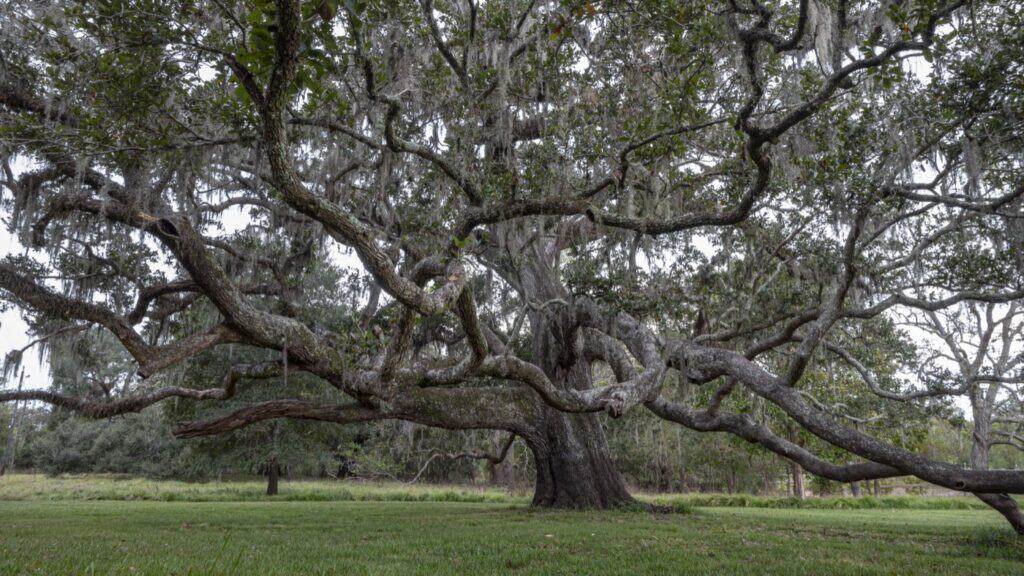
- Birds and scenery: herons, spoonbills and live oaks hung with Spanish moss come up again and again
- Trails: flat, wide and well kept, with water refill stations along the way. Some hikers find them too easy, and a few were caught out by trails closed after rain
- Restrooms: mostly praised as clean, with hot showers. A handful of reviews found them dirty or the showers weak
- Mosquitoes: the most common complaint, worst after rain and in summer. Visitors bring strong repellent and long sleeves, even in winter
- Low water: several visitors in spring 2026 found the lakes very low and the fishing poor
Getting There
Brazos Bend State Park is about 42 miles southwest of downtown Houston. From Houston, take I-69/US 59 south to the Crabb River Road exit (FM 2759), follow it to FM 762 and continue south to the park. Brown park signs mark every route.
The other route from Houston, also used from the south, is SH 288 to FM 1462 west, then north on FM 762. Rosharon, about 13 miles away on SH 288, is the closest town by road.
Drive times to park headquarters:
- Houston: about 1 hour 5 minutes
- Austin: about 3 hours 15 minutes
- San Antonio: about 3 hours 40 minutes
- Dallas: about 5 hours 15 minutes
A few things to know before driving out:
- Late arrivals: the headquarters office closes at 5 p.m. Later visitors pay at the self-pay box beside headquarters, and day visitors must leave by 10 p.m.
- On the road: visitors report alligators and hogs crossing the park roads, and rangers ticketing speeders
Know Before You Go
Alligators, heat and mosquitoes shape every visit to Brazos Bend State Park. These fees, rules and tips matter most.
- Fees and passes: $7 a day for ages 13 and older; children 12 and under get in free. The Texas State Parks Pass ($70 a year) covers entry for the holder and guests. Confirm current fees on the TPWD fees page
- Booking: day passes open 1 month ahead and come in three entry windows: 8 a.m. to 1 p.m., 1 to 5 p.m. and 5 to 10 p.m. Any left are sold at the gate. Campsites open 5 months ahead
- Hours: the park is open 8 a.m. to 10 p.m. daily, and the gate locks at 10 p.m. The headquarters office closes at 5 p.m.
- Water: no swimming, wading or boating anywhere in the park, because of alligators. Portable pools are banned too
- Dogs: allowed on a leash of 6 feet or less, attended at all times. Keep dogs out of the lakes, don’t throw anything in the water for them to fetch, and leave them out of shelters, the cabin and all buildings
- Bugs and heat: bring strong insect repellent and plenty of water
- Fires: a burn ban has been in effect since Aug. 28, 2026, so no wood fires
- Alcohol: drinking or displaying alcohol in public areas is against park rules
- Hunts and races: the whole park closes for public hunts Nov. 17–19 and Dec. 15–17, 2026, from 2 p.m. the day before until 8 a.m. the day after. Partial hunts can close the trails north of Big Creek, and trail races in April and December fill the parking lots
- What to bring: binoculars, bug spray, water, sturdy walking shoes and a day pass reserved before leaving home
Check conditions first: trails close after rain, and the park closes for hunts, burns and races. Check the Brazos Bend park alerts page or call (979) 553-5101 before driving out.
Nearby Parks
Three other TrekTexas guides are within about two and a half hours of Brazos Bend State Park.
- Stephen F. Austin State Park: about 56 miles north in San Felipe, with 5 miles of trails along the Brazos River and full-hookup camping
- Huntsville State Park: about 106 miles north, with swimming and kayak rentals on Lake Raven and 21 miles of trails
- Lake Livingston State Park: about 116 miles northeast, with swimming, boating and fishing on one of the largest lakes in Texas
- More parks within reach of Houston: Parks Near Houston
FAQ
Can visitors swim at Brazos Bend State Park?
No. Swimming, wading and boating are banned in every lake and creek in the park because of the alligators.
Are there cabins at Brazos Bend State Park?
There is one cabin, a converted shelter with air conditioning and a bunk bed but no bathroom, for $75 a night. The park also has 13 screened shelters for $25 a night.
Does a George Observatory ticket include park entry?
No. Observatory tickets come from HMNS, and every visitor 13 and older also needs a $7 park day pass or a Texas State Parks Pass.
Are the alligators at Brazos Bend dangerous?
They are wild animals, but visitors describe them as calm and uninterested in people. Staying at least 30 feet away, never feeding them and keeping dogs on a short leash away from the water are TPWD’s main rules.
Sources and Official Links
Facts in this guide were last checked in October 2026 against these sources.
- Brazos Bend State Park (TPWD)
- Entrance fees, campsites, screened shelters and cabin (TPWD)
- Trail list and park trail map (PDF) (TPWD)
- Park alerts and events (TPWD)
- Alligator safety and accessibility (TPWD)
- Texas State Parks reservations
- George Observatory admission and Saturday stargazing (Houston Museum of Natural Science)
Featured photo: Larry D. Moore, Wikimedia Commons (CC BY 4.0)
Get More Texas Outdoor Adventure Tips
Subscribe to get more places to explore in the great outdoors of Texas. We’ll never share your email. Unsubscribe any time.